




A Brief History of Period Products

Ever stopped to wonder how we got the array of menstrual products we have today? I didn't think so, but you're going to now :-)
Here's a brief history of period products and how we went from rags to revolution, and back again!
Before recorded time → Early 1900s: The OG reusable era
Cloth, wool, rags, even moss. Worn, washed, reused. No packaging, no waste, no drama. Reusable period care isn't a modern idea - it's the original idea.
1896: The first disposable pad arrives
Lister's Towels were the first commercially sold disposable pad. They flopped. Women were too embarrassed to buy them. The world wasn't ready.
Early 1900s: Nurses change everything (like the champions they are!)
WWI nurses discovered that cellulose bandaging material absorbed menstrual blood brilliantly. They started using it themselves. Kotex took note. By 1920, the modern disposable pad was born, and this time, it caught on.
1930s: The tampon enters the chat
Dr. Earle Haas invented the modern tampon (compressed cotton with a cardboard applicator) in 1931. Tampax (which was actually founded by a woman, Gertrude Tendrich) purchased the patent and trademark and began selling them shortly after. Convenient, discreet, and revolutionary. And yet...
Doctors debated whether they were "safe." Religious groups clutched their pearls. There were genuine, serious concerns that insertion might be *pleasurable* — and that simply could not be allowed. Unmarried women were advised against them entirely, lest a tampon do what apparently only a husband should. How's the audacity of a woman touching her own body! insert fake shock
Controversial or not, women decided for themselves, and they were widely adopted by the 1940s and 50s.
1930s–40s: The cup that time forgot
The internal menstrual cup was already being sold in the 1930s. But it was a tough sell. Women were still embarrassed to buy pads in public, let alone something internal. War-era rubber shortages didn't help. The cup quietly faded out.
1950s–60s: The weird middle era
Before adhesive pads, things got creative. The sanitary belt - an elastic band with clips front and back - was how most women kept pads in place. Some women even used external plastic receivers worn inside their underwear, clipped to a belt-like device designed to catch the flow without anything internal. It was the era of "there has to be a better way," and women were clearly trying to find it.
Late 20th century: Disposables become the default
Pads got thinner. Tampons got more discreet. By the 80s and 90s, single-use products were just what you used. Convenient, yes. But quietly generating a mountain of waste with every cycle.
1987: The cup quietly comes back
A rubber menstrual cup called The Keeper relaunched the category for a new generation. No fanfare, no supermarket shelf. Mostly sold at health food stores and by mail order. But for the women who found it, it was a revelation.
2010s: Period underwear goes mainstream
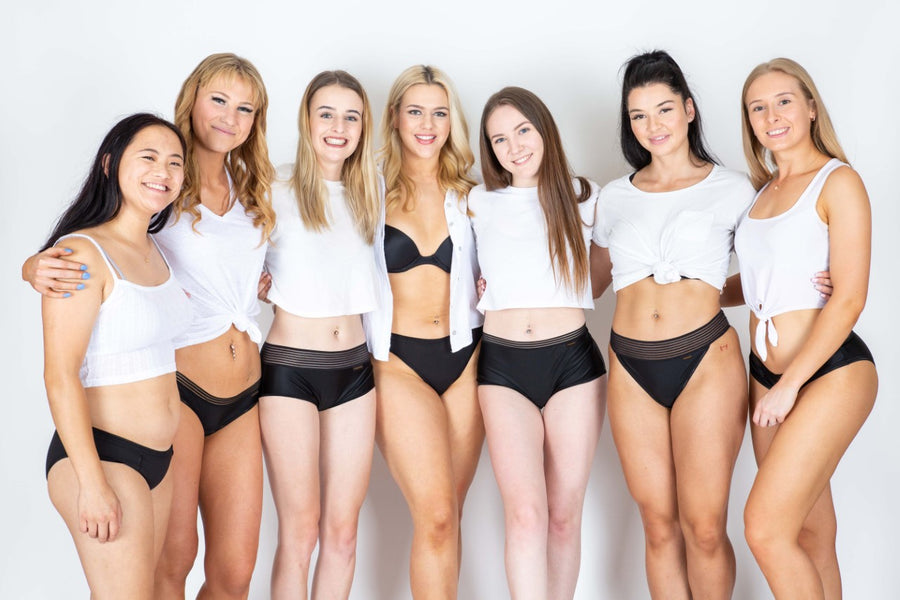
The first modern period underwear brands launched between 2012 and 2015. Absorbent, washable, and designed to look and feel like real underwear. A category that barely existed became a staple. The reusable era had a proper comeback - just with better fabrics and a lot more R&D behind it.
Now: Full circle, done better
We're back where we started - reusables - but with decades of design and real-world feedback behind us. Period underwear that lasts years. Less waste. More comfort. Fewer compromises.
So we haven't gone backwards. We've just taken what's always made sense, but made it better.
*Want to find the right fit for your flow? Check out this blog article here.
*Photo by University of Washington Libraries on Unsplash